Navigating Toddler Frustration with Calm and Confidence: A Practical Reset for Tantrums, Big Feelings, and Everyday Power Struggles
Toddler frustration can look loud, sudden, and relentless—but it’s often a sign of growing skills colliding with limited impulse control, language, and patience. When your child wants independence faster than their brain and body can deliver it, the result is a nervous-system spike that shows up as yelling, flopping, hitting, or refusing. Our team put this guide together to give you a calm, repeatable way to respond to tantrums and daily meltdowns without giving in, shutting down, or feeling like every moment is a test. We’ll also share two practical digital tools from our store that can help you stay consistent when you’re tired and the day is moving fast. For more guidance, see The Children and Screens Guide for Early Child ….
What Toddler Frustration Really Means (and Why It Spikes So Fast)
Most toddler blowups are “skills gap” moments: your child wants to do it alone, wants it now, and doesn’t yet have the words, coordination, or impulse control to make that happen. Common triggers include transitions, hunger or tiredness, sensory overload, feeling rushed, not being understood, sudden limits, and sibling sharing. A tantrum isn’t a parenting grade—it’s a nervous-system event. Your goal is safety, connection, and clear boundaries, not perfect quiet. For further reading, see Parent training for the treatment of irritability in children and ….
A helpful reframe is that behavior is communication. The message might be “too hard,” “too fast,” “I need help,” or “I need control.” When you respond to the message (without removing the boundary), you teach your child how to move from escalation to regulation over time. For additional evidence-based guidance, you can also review the American Academy of Pediatrics’ overview of tantrums at HealthyChildren.org.
| Trigger |
What it can feel like to a toddler |
Supportive parent response (short) |
| Transition (leaving, bedtime, cleanup) |
“I’m losing something I want.” |
Name it + preview the next step + offer a small choice |
| Blocked goal (toy won’t work, can’t open snack) |
“I can’t do it and I’m stuck.” |
Validate + coach one step + offer help without taking over |
| Limit (no screen, no candy, stop hitting) |
“You’re stopping me.” |
Hold boundary + empathize + give a safe alternative |
| Overload (noise, crowds, too many instructions) |
“Everything is too much.” |
Reduce input + simple phrases + calm body support |
The Calm-and-Confidence Response: A Simple 5-Step Script
When your toddler is spiraling, long explanations usually add fuel. A short script helps you stay steady and predictable—two things that make limits feel safer (even when your child dislikes them).
Step 1: Regulate first
Soften your voice, lower to your child’s level, and slow your breathing. Your calm nervous system is often the fastest de-escalator available.
Step 2: Name the feeling and the want
Keep it basic: “You’re mad. You wanted the blue cup.” Simple language helps shift the brain from panic to processing.
Step 3: Hold the boundary clearly
One sentence, no debate: “The blue cup is in the dishwasher. We’re using the red cup.”
Step 4: Offer a small choice or a next action
Choices restore a sense of control without changing the limit: “Red cup now or water bottle?” Or offer a safe body outlet: “Hands down—stomp feet or squeeze this pillow.”
Step 5: Repair and teach after the storm
Build Frustration Tolerance in Everyday Life (Not Just During Tantrums)
Quick-reference (copy-friendly)
| When |
Do this |
Say this |
| Early whining |
Offer a choice |
“Do you want A or B?” |
| Escalating crying |
Validate + simplify words |
“You’re frustrated. I’m here.” |
| Unsafe behavior |
Block + boundary |
“I won’t let you hit.” |
| After calm returns |
Teach one replacement skill |
“Next time, say ‘help.’” |
What’s Inside Our “Navigating Toddler Frustration with Calm and Confidence” eBook (and Who It’s For)
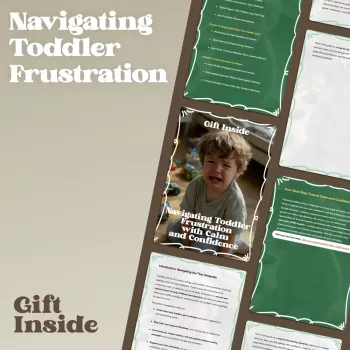
Navigating Toddler Frustration with Calm and Confidence – Practical Parenting eBook on How to Cope with Toddler Frustration, Tantrums & Emotional Development is $15.99 (digital download).
A Calm Home Plan: Pair Tantrum Tools with Your Own Daily Reset
| Minute |
Action |
| 0:00–1:00 |
Slow breathing + set one intention: “Calm voice, clear boundary.” |
| 1:00–2:00 |
Preview today’s hardest transition and choose your script in advance. |
If you want something you can print or keep on your phone for a quick start, our team also offers: Morning Routine Checklist for a Positive Mindset | Daily Morning Routine for Positive Mindset, Printable Digital Checklist for Focus, Gratitude & Productivity ($3.99, digital). When your baseline is steadier, it’s easier to deliver the same calm script at home, in the car, and in public.
FAQ
What’s the difference between a tantrum and a meltdown?
A tantrum is often a protest linked to a goal or limit (like “I want that” or “I don’t want to leave”), while a meltdown is more of an overload where your child can’t access regulation skills. There’s overlap, so either way, prioritize safety, reduce input, stay close, and hold calm boundaries.
Should tantrums be ignored or addressed?
Stay present and calm rather than ignoring your child completely, while also avoiding rewarding unsafe behavior. Validate feelings, keep the boundary, and save teaching for after your child is calm—short phrases work better than lectures during peak upset.
How long does it take for calmer tantrum responses to work?
Most families notice gradual improvement over weeks as your child learns the pattern and your consistency builds trust. Track progress by faster recovery, fewer unsafe behaviors, and more attempts to communicate needs with words or simple cues.
Recommended for you












Leave a comment